
Men in Bury can expect 57.4 years in good health, the lowest since records began in 2011-13. England's is 60.9. Councillors see the report on 26 November.
A baby boy born in Bury can expect to live 57.4 years in good health. That is the lowest figure for the borough since the series began in 2011-13. For girls the figure is 58.2 years.
The numbers are in the Director of Public Health’s annual report for 2025/26, called Health Beyond Healthcare. It goes to the council’s Health Scrutiny Committee on Thursday 26 November.
Overview
- Men in Bury: 57.4 years in good health (2022-24), against 60.9 for England.
- Women in Bury: 58.2 years, against 61.3 for England.
- In 2018-20: the Bury figures were 62.7 years for men and 63.6 for women.
- The caveat: the estimate for a single borough has a wide margin, so official statistics do not count Bury as significantly worse than England.
How far it has fallen
Healthy life expectancy is the average number of years a person can expect to live in good general health. It is worked out from death rates and from what people say about their own health in national surveys.
The report says the male figure of 57.4 years is “the lowest (worst) it has been since at least 2011-13”. The published series on the government’s Fingertips health data bears that out for both sexes. Bury men stood at 61.8 years in 2011-13 and peaked at 62.7 in 2018-20. The figure has fallen in each three-year period since.
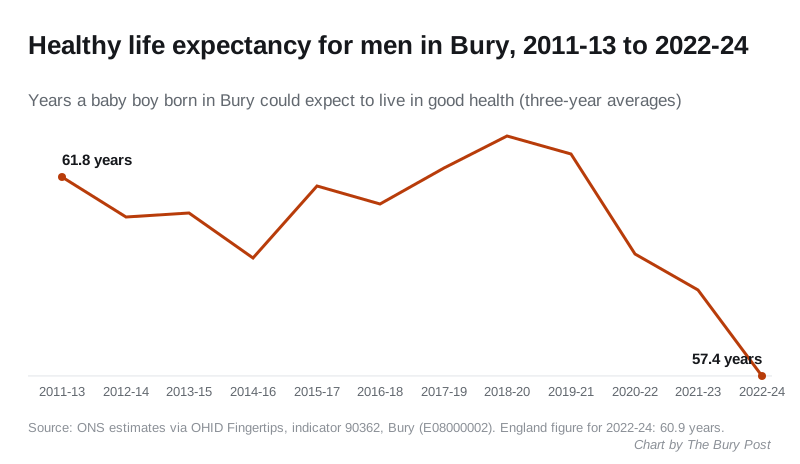
England has fallen too, from 63.1 years for men in 2018-20 to 60.9 in 2022-24. Bury has fallen further. The gap with England is now 3.5 years for men and 3.1 years for women.
There is an important caveat. The survey behind these figures is small at borough level. The 95% confidence range for Bury men runs from 53.1 to 61.6 years. On that basis Fingertips rates Bury as “similar” to England rather than worse. The direction over several releases is clearer than any single number.
What else the report found
The report sets health against what it calls the “building blocks”: money, work, housing, schooling and transport. Its Bury figures include:
- Child poverty: 25.5% of children under 16 lived in low-income households in 2024/25, down from 27.8% a year earlier. The England average is 19.8%.
- Work: 70.1% of people aged 16 to 64 were in employment in 2024/25. That is below the North West (73.7%) and England (75.7%).
- Unemployment: 5.3% in 2025, up 1.3 percentage points on 2024.
- Fuel poverty: 9.7% of households in 2024, down from 13.4% in 2021.
- Rent: 59% of Bury residents find it difficult to afford rent, against 46% across Greater Manchester.
- Starting school: 65.2% of children reached a good level of development at the end of Reception in 2024/25. The England figure is 68.3%.
The report names Radcliffe and Bury East as places with deprived areas. It says the main causes of the gap in life expectancy between rich and poor are heart and circulatory disease, cancers and liver disease.
What the council says it is doing
The report’s answer is prevention close to home. It says the Bury Live Well service has run more than 220 community drop-in sessions and had more than 2,600 conversations with residents in the last year, on subjects such as stopping smoking.
Whitefield’s Live Well Centre opened in August as the first in the borough. The report says it should shape further centres elsewhere in Bury.
Its recommendations for 2026/27 and 2027/28 include:
- more Live Well neighbourhood centres working with voluntary and faith groups
- more screening and early checks for long-term conditions in community venues
- treating loneliness and mental wellbeing as a public health priority
- continuing to restrict new unhealthy food outlets through planning and licensing
- building evaluation into at least 90% of prevention schemes
The council’s Health Inequalities Strategy has a target to cut the life expectancy gap between the borough’s best and worst areas to under 13 years for men and 10 years for women. The report does not give the current size of that gap.
What it means for you
The report does not change any service on its own. Councillors on the Health Scrutiny Committee will be asked to note it and its recommendations at Bury Town Hall at 7pm on 26 November. The meeting is open to the public.
Free NHS Health Checks are offered to adults aged 40 to 74 without an existing heart condition, diabetes or kidney disease. Ask your GP practice whether you are due one.
Have your say