

Full Council votes on 11 November on sending Bury's Local Plan, with 9,486 homes to 2043, to a government inspector. The plan has land for 11,246.
Bury councillors vote next Wednesday on the plan that will guide building in the borough until 2043. It sets a target of 9,486 new homes.
Full Council meets at Bury Town Hall at 7pm on 11 November. The agenda asks members to send the Local Plan to the Secretary of State for independent examination.
There is a hard deadline. The report to councillors says the plan must be submitted by 31 December 2026 to stay under the old plan-making rules. After that, the council would have to work under the new system that began in March.
Next week’s vote does not adopt the plan. An inspector tests it first, and adoption comes back to Full Council later.
Where the 9,486 homes come from
The target is not new. Places for Everyone, the joint plan adopted in March 2024, already set it up to 2039. The Local Plan adds four more years at the same minimum rate.
The yearly target changes over the period:
| Years | Homes a year |
|---|---|
| 2022 to 2025 | 246 |
| 2025 to 2030 | 452 |
| 2030 to 2039 | 520 |
| 2039 to 2043 | 452 |
The council says it has room for more than the target. It counts land for 11,246 homes, which is 18.6% above what is required:
- Places for Everyone allocations: 5,279
- Other sites in town centres: 2,135
- Sites under construction or with permission: 2,084
- Homes already built, 2022 to 2025: 836
- Other sites outside town centres: 570
- Small sites not yet identified: 342
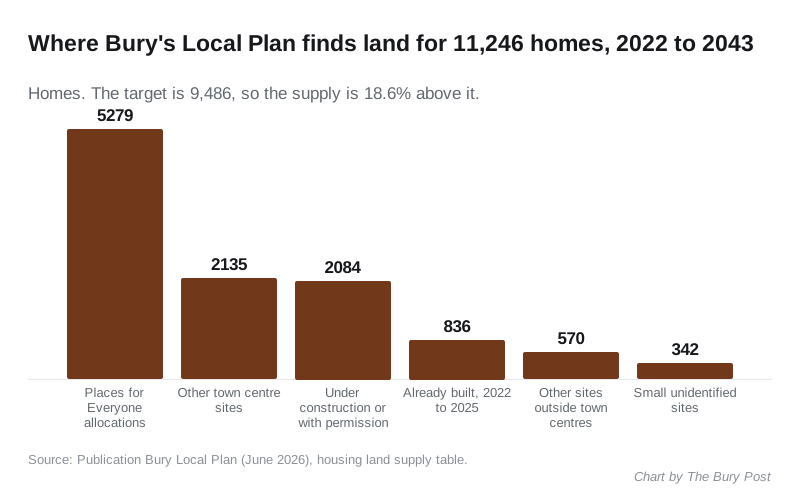
Nearly half of that supply is land already allocated in Places for Everyone. That means Elton Reservoir, Walshaw and Simister among others, and those sites are not reopened by this plan. The council’s position is that no further Green Belt land needs to be released. Our planning news page explains how the two plans fit together.
What the plan would change
The Local Plan’s own policies decide how applications are judged. On affordable homes, it asks for:
- 10% on schemes of 10 to 24 homes
- 25% on schemes of 25 homes or more
- 15% in town centres, where the council’s viability study says a higher figure would stop schemes going ahead
The plan puts the need at 1,017 affordable homes a year, if the backlog were cleared over 10 years. That is more than twice the average building target of 452 a year, and the council accepts planning policy alone cannot meet it.
It also carries policies on houses in multiple occupation, betting shops, food and drink premises and homes for older people, among others. Once adopted, it replaces what remains of the old Unitary Development Plan.
What people told the council
The final round of comments closed on 11 September. The council received 103 representations from 100 people and organisations. The inspector will only consider those about whether the plan is “sound”, the legal test it has to pass.
The council’s summary records these among the main points:
- The housing target is out of date and should rise, some respondents said.
- Affordable housing demands, especially the 50% proposed on Green Belt sites, may be unviable.
- Health services need to be built alongside new housing.
- One response objects to anything enabling the loss of Milton Road Fields in Radcliffe.
The council’s answer on Milton Road is notable. It says the Local Plan “identifies the site at Milton Road as protected open space”. Cabinet agreed in October to sell the same land for the Ash Grove academy, and that decision has since been sent back.
Also on the agenda
- A joint planning committee with Rochdale: a report proposes it to decide applications at Northern Gateway.
- A consultation review: a Radcliffe First motion asks for a review of how the council consults, with proposals for a council-wide framework within six months.
What it means for you
- The chance to comment has passed. The final round closed on 11 September, and those comments now go to the inspector.
- You can still ask a question. The agenda sets aside up to 30 minutes for public questions, and notice has to be given in advance.
- This does not decide any one site. Each scheme still needs its own planning application. The plan sets the rules those applications are judged against.
We will report the result of the vote. The full documents are on the council’s Local Plan page.
Have your say