

Bury Council has a C3 grade from the housing regulator over safety data, repairs and tenant engagement at its 7,600 homes. Published 11 November 2026.
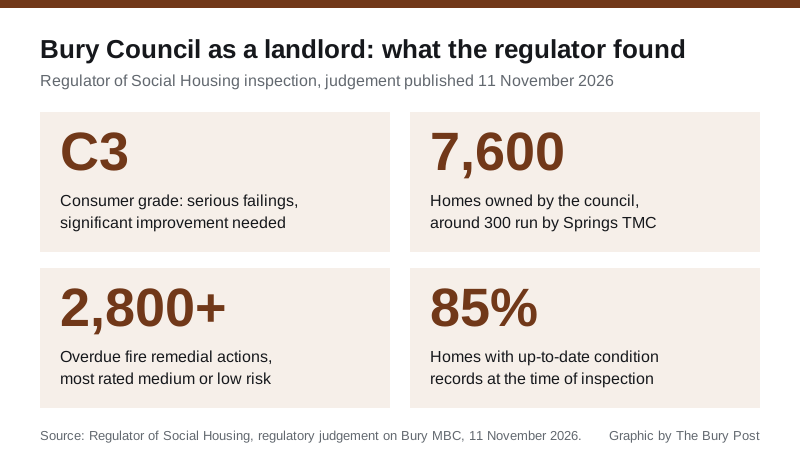
Bury Council has been given a C3 grade by the Regulator of Social Housing for how it runs its council homes, the second-lowest of four grades, after an inspection found serious failings in tenant safety information, engagement with tenants and the information it gives them.
The council owns around 7,600 homes. The regulator published its regulatory judgement this morning, Wednesday 11 November. It is the first time the regulator has given Bury a consumer grade; it began inspecting landlords under revised consumer standards in April 2024.
The regulator is not taking enforcement action for now, but says it will keep that under review and that its engagement with the council “will be intensive”.
What the inspection found
Safety information. The regulator said Bury’s reported health and safety compliance “is good in most areas”, but the council “could not provide sufficient assurance on the accuracy” of that information, which it called a serious failing. At the time of the inspection the council had more than 2,800 overdue fire remedial actions. Most were rated medium or low risk, but the regulator said there was “a lack of clarity about the length of time they have been open”.
Damp, mould and repairs. Bury could not show it was meeting the legal timescales to investigate, identify and repair hazards including damp and mould. It is missing its targets for how quickly repairs are done, including aids and adaptations, and could not vouch for the accuracy of repairs figures it had reported in the past “due to historical data quality issues”.
The condition of homes. The council had up-to-date records for around 85% of its homes, based on physical surveys. The regulator saw “significant fluctuations” in how many homes the council reported as meeting the Decent Homes Standard, as staff worked to check their data, and said Bury needs to strengthen its assurance that homes meet that standard.
Tenants’ voice. The regulator found “limited evidence of meaningful opportunities” for tenants to scrutinise the council or influence its services, and said it saw “evidence of a breakdown in trust between tenants and Bury MBC, which was acting as a barrier to meaningful engagement”. The council’s main tenant engagement structures were being reviewed with outside help at the time.
Information for tenants. The council told inspectors it takes a “website-first” approach to communications, but could not show that tenants who are not online could reliably get accurate information about services. Bury has also failed to meet the technical and survey requirements of the Tenant Satisfaction Measures, the national landlord performance figures, since they were introduced, partly because subcontracted repairs were left out of its performance data.
Anti-social behaviour, complaints and diverse needs. The council had itself found that its handling of anti-social behaviour and hate incident cases needed significant improvement, with policies applied inconsistently and affected tenants “not always” adequately supported. A plan drawn up with specialist support was under way but not yet showing consistent results. The regulator also found weaknesses in complaint handling and in how well the council understands and meets tenants’ different needs.
Around 300 of the council’s homes are managed by the Springs Tenant Management Cooperative. The regulator said Bury could not show that all required actions from legally required health and safety assessments had been carried out in those homes.
What the regulator said the council is getting right
The judgement says Bury is reducing its backlog of overdue repairs, is taking steps to improve the quality of its data and has further improvements planned. A communications plan was drawn up after an outside review, and a separate external review of complaints has recently finished.
The regulator said Bury “has been engaging constructively with us, has demonstrated that it understands the issues it needs to address, and is taking action to rectify the failings and weaknesses identified.”
Kate Dodsworth, the regulator’s deputy chief executive, said:
“It’s really important that landlords give tenants meaningful opportunities to scrutinise their performance.
“They should listen carefully to what tenants say and act on this to improve their services.
“They also need to have accurate health and safety information to make sure tenants’ homes are safe and carry out repairs promptly when needed.”
What C3 means
The regulator grades landlords from C1 to C4, where C4 is the lowest. A C3 means, in its words, “there are serious failings in the landlord delivering the outcomes of the consumer standards and significant improvement is needed”. Councils receive only a consumer grade, not the governance and financial grades given to housing associations. The regulator’s guidance on grades explains the scale.
Inspectors observed meetings of the council’s Housing Advisory Board, Cabinet and the Tenant Voice Complaints Group, and met tenants, officers and lead councillors.
What it means for you
If you are a Bury Council tenant, your tenancy is not affected: the regulator found the council’s tenancies meet legal requirements. The judgement is about how the council runs its housing service, and the regulator will be checking on its progress.
The regulator does not handle individual complaints. If you have a problem with a repair, damp or mould, or anti-social behaviour, report it to the council first, then use its complaints process. If that does not resolve it, the Housing Ombudsman deals with individual complaints about social landlords.
The judgement comes as the council prepares to take on the 103 homes still owned by Six Town Housing, which is closing; we reported on that plan here.
The regulator also published financial stability checks on 19 housing associations today, including Peabody, Sanctuary and The Guinness Partnership. All 19 kept their V2 viability grade.
Have your say