
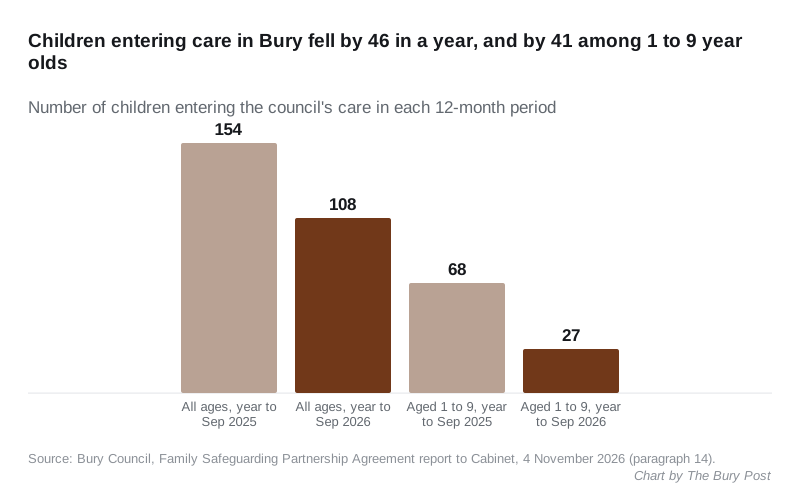
108 Bury children entered care in the year to September, down from 154. Among 1 to 9 year olds it fell from 68 to 27. Cabinet has approved £490,618 to keep the model going, subject to call-in.
Fewer children are being taken into care in Bury. 108 children entered the council’s care in the 12 months to the end of September 2026, against 154 in the year before.
Updated 5 November: the council’s record now lists the agreement as “Recommendations Approved (subject to call-in)” after the 4 November Cabinet.
The biggest fall is among younger children. 27 children aged 1 to 9 entered care in the latest year, down from 68. In the four years before that, the average was 34.
The figures are in a report to Bury Council’s Cabinet for its meeting on Wednesday 4 November. The council credits a way of working called Family Safeguarding, and it is asking Cabinet for £490,618 to keep it running for another 12 months.
What Family Safeguarding is
Bury adopted the model in 2023. It was one strand of the council’s improvement plan after Ofsted rated its children’s services inadequate in 2021, the report says.
The idea is that social workers do not work alone. Each team also includes specialists who deal with the problems of the adults in the family:
- mental health practitioners from Pennine Care NHS Foundation Trust
- drug and alcohol recovery workers from Early Break
- domestic abuse officers from the Probation Service
- a clinical psychologist
The report explains why. Of the 1,400 assessments of children newly referred to the service so far in 2026, two-thirds identified problems with the parents. The most common were:
- parental mental health, in 32%
- domestic abuse, in 29%
- alcohol misuse, in 19%
- substance misuse, in 13%
Those adults often do not meet the threshold for adult services on their own, the report says. Putting the adult specialists in the children’s team gets them help anyway.
What the money pays for
The £490,618 would come from the council’s Supporting Families reserves. It pays the partner organisations for their staff in the teams:
| Partner | Role | Cost for 12 months |
|---|---|---|
| Pennine Care NHS Foundation Trust | Mental health practitioners | £193,929 |
| Probation Service | Domestic abuse officers | £149,503 |
| Early Break | Substance recovery workers | £147,186 |
| Total | £490,618 |
The old agreement with the partners has expired, which is why it is back at Cabinet. A new agreement would cover the NHS Greater Manchester Integrated Care Board, Pennine Care, the Probation Service, Early Break and Greater Manchester Police.
The report looked at two other options and rejected both. Stopping the funding would mean Bury was no longer a Family Safeguarding authority. Cutting it would leave too few specialists to run the model as designed.
What else the figures show
The council also follows up children the teams were working with. Of the children supported at the end of March 2025, 10% had seen their needs escalate by the end of September 2026, and 7% had entered care. For the group a year earlier, the same figures were 13% and 8%.
The report puts those small percentages in context. One percentage point is about six children. A child in foster care costs an average of £45,000 a year. On that basis it estimates that the lower number entering care in the latest year means about £2m less pressure on the budget for children’s homes and placements.
Not everything has moved. The report says the picture across the rest of children’s services is “more mixed”:
- child protection enquiries and child protection plans remain relatively high compared with similar councils, although plans have fallen 7% in a year
- requests for help from partner agencies have not come down
A peer review in March 2026 by the Centre for Family Safeguarding Practice, which designed the model, found “a clear trajectory of improvement”. It recommended strengthening the model rather than changing direction.
One small inconsistency. The council’s press release and the report’s own figures give a fall of 46 (154 to 108). A later paragraph of the same report describes it as a difference of 45.
What it means for you
- If your family is working with a social worker in Bury, the team may include a mental health, drug and alcohol or domestic abuse worker for the adults as well. That is the model, and Cabinet is being asked to fund it for another year.
- If you want to follow the decision, Cabinet meets on Wednesday 4 November. The agenda and report are on the council’s decisions site. The same meeting will consider charges at 22 free car parks, covered in our report on district car park charges.
- If you are worried about a child, Bury’s Multi Agency Safeguarding Hub is on 0161 253 5678, or 0161 253 6606 outside office hours, according to the council’s report a child at risk page. If a child is in immediate danger, call 999.
The council’s budget, which pays for children’s services, is out for consultation. Our report on the budget gap has the detail.
Sources
- Bury Council, Family Safeguarding Partnership Agreement, report to Cabinet, 4 November 2026.
- Bury Council, press release, 30 October 2026.
Have your say